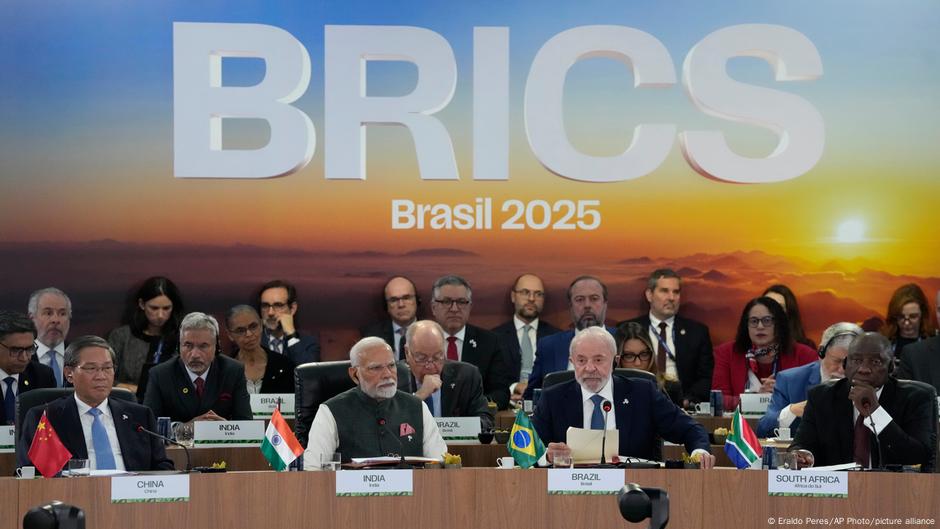
The Growing Tensions in the Iran Crisis and BRICS’s Dilemma
As the Iran crisis intensifies, the BRICS bloc is under increasing pressure to respond. However, internal rifts and competing interests are significantly limiting its ability to act as a unified geopolitical actor. This challenge has become even more complex with the inclusion of Iran in the group, which has added new dimensions to the existing tensions.
Tehran has called on the BRICS bloc, currently chaired by India, to take action in the ongoing conflict between the US and Israel. As a member of BRICS since 2024, Iran is advocating for a strong collective stance against what it describes as “military aggression.” It also wants the bloc to play a more significant role in maintaining regional stability.
India, however, has taken a cautious approach, urging restraint, de-escalation, and dialogue. Analysts suggest that Washington views this as strategic positioning rather than solidarity with Tehran. India’s Foreign Ministry spokesperson, Randhir Jaiswal, highlighted the challenges of forming a consensus among BRICS members, given the varying levels of involvement in the Middle East conflict.
“India has been facilitating discussions among members through the Sherpa channel,” he said, referring to the primary communication and coordination mechanism within the bloc.
What Can BRICS Do?
Experts have pointed out that despite Iran’s expectations, BRICS’s capacity to respond effectively is limited. The expanded membership has deepened internal divisions, with Gulf nations like the UAE and Saudi Arabia wary of Iran. Other members are reluctant to take a stance that could be seen as opposing the United States.
Shanthie Mariet D’Souza, president of Mantraya, an independent research forum, noted that while BRICS has potential as a dialogue platform, it may be unrealistic to expect a joint statement or any form of intervention.
“It can occur when the conflict reaches a hurting stalemate for the member countries,” she explained. D’Souza added that Iran has inherent issues with the UAE and Saudi Arabia, making consensus difficult.

She emphasized that although Iran is involved in the conflict, it is primarily responding to US-Israeli aggression. This complicates the situation further for BRICS, as it must navigate the complexities of its own membership.
Energy Stakes and India’s Dilemma
D’Souza also highlighted that India, as the BRICS chair, plays a crucial role in building consensus. This gives it the authority to issue a statement on behalf of the bloc. However, she argued that any such move would have little impact on the actions of the US and Israel in Iran.
“BRICS is incapable of even stating a principled position,” she said. Former Indian ambassador to the US, Meera Shankar, echoed this sentiment, noting that a consensus statement seems unlikely at this stage.
“BRICS is not an alliance of like-minded countries,” Shankar said. “It is a loose grouping with a broad-based agenda encompassing trade, development, economic cooperation, and strengthening multilateralism.”
Despite these challenges, there are many areas where the bloc’s members find it worthwhile to work together, even if they disagree on other issues.
India’s Balancing Act
Iranian President Masoud Pezeshkian has spoken with Indian Prime Minister Narendra Modi, while Foreign Minister Abbas Araghchi has had multiple calls with his Indian counterpart, S Jaishankar, about activating BRICS for stability and condemnation of US-Israeli strikes.
Gulshan Sachdeva, professor at Centre for European Studies of Jawaharlal Nehru University, pointed out that despite holding the BRICS presidency, New Delhi has remained relatively low-profile on the US-Israel war on Iran. He noted that the disruption to shipping in the Strait of Hormuz, which India relies heavily on for energy imports, is forcing New Delhi to rethink its position.
Sachdeva also mentioned that Tehran has started allowing Indian-flagged vessels to pass through the Strait of Hormuz on a case-by-case basis, though it may expect reciprocal political signaling. He added that Iran may expect a strong statement from BRICS, but India must also balance the positions of other regional members such as Saudi Arabia and the UAE.
Both countries host US military bases and have faced Iranian strikes during the conflict. Sachdeva concluded that the outcome of India’s BRICS presidency will depend on whether it actively mobilizes the bloc against the attack on one of its members and pushes for de-escalation or settles for low-profile procedural meetings with lackluster outcomes.
A Bloc Split by Competing Interests
The crisis has exposed sharp divisions within BRICS, with members on opposing sides and India notably avoiding criticism of US-Israeli strikes. Ajay Bisaria, a former diplomat, told that the crisis in the Middle East has exposed the political contradictions within the expanded BRICS.
“Its members are on opposing sides of a kinetic conflict, with Iran striking infrastructure in Saudi Arabia and the UAE,” he added. Bisaria noted that India, in its posture as chair, defines BRICS as a “non-western” economic club rather than an “anti-Western” security alliance.
“The failure to issue a joint BRICS statement underlines the geopolitical limitations of the bloc and its economic ’emerging economy’ focus,” he said. Bisaria emphasized that as BRICS chair, India could potentially adopt a more forward-leaning posture.
“It could issue a chair statement expressing grave concern at the attack and on the continuing hostilities involving a BRICS member,” he suggested, adding that the bloc could call for an immediate pause in hostilities to enable “dialogue and diplomacy.”
More importantly, he said the crisis also offers India an opening to potentially act as a peace facilitator, perhaps along with some other neutral BRICS members.
D’Souza pointed out that this was not the first time that BRICS has faced such a challenge, and even the Ukraine war, in which Russia was the aggressor, exposed the organization’s limited ability to forge consensus.
“In today’s world, multilateral forums and regional organizations seem to have reduced leverage over state actions,” she said.

Bahran Hariz adalah seorang penulis di Media Online IKABARI.