A Journey of Remembrance and Gratitude
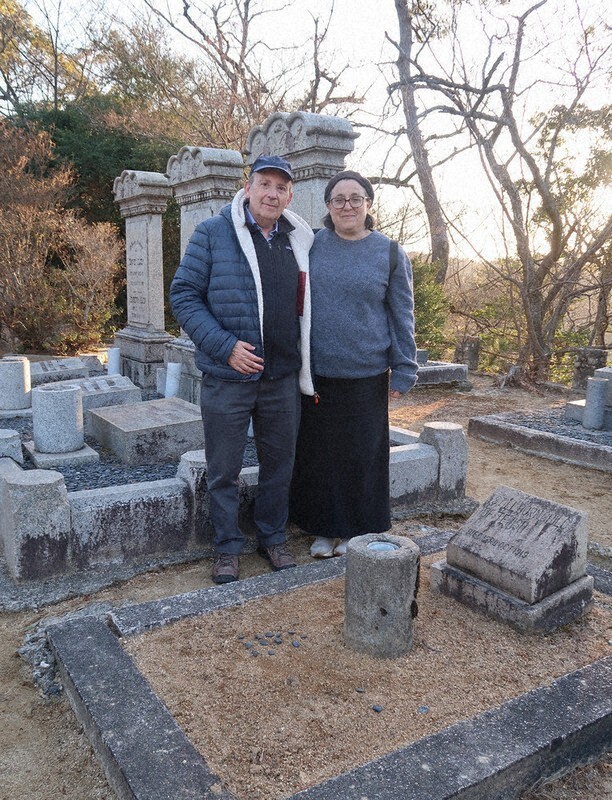
In February, Hadassa Pardes, a 58-year-old descendant of a Jewish family that fled to Japan during World War II, visited the grave of her relative in Kobe, Hyogo Prefecture. This marked a significant moment for her and her husband, David, as they paid their respects at the resting place of her uncle, who died shortly after birth 86 years ago. The newborn was Hadassa’s mother’s younger brother, and this visit was the first time a family member had been able to say a prayer at his grave.
The couple traveled to Japan for the first time after recently discovering the existence of the grave. Hadassa’s grandparents, along with their two young children—including her mother—were saved by transit visas issued by Chiune Sugihara, a Japanese diplomat stationed in Lithuania. These visas allowed them to escape the growing threats posed by Nazi Germany and the Soviet Union’s annexation of Lithuania.
On February 17, the Pardes family visited the Kobe Municipal Foreign Cemetery in the city’s Kita Ward. “We were very grateful that now, 80 years later, for the first time, a family member of that little boy was able to say a prayer at his grave,” Hadassa said. Following the ceremony, the couple placed pebbles on the grave, a tradition in Jewish customs. The event was live-streamed via smartphone, allowing relatives in Israel and the United States to join in the moment.
Hadassa’s grandfather, Chaim Nussbaum, was born in Poland and grew up in the Netherlands. As a rabbi teaching at a seminary in Lithuania, he faced the outbreak of World War II in 1939. With the Jewish community under increasing threat, Chaim received visas from Sugihara in 1940 and fled to Japan through Siberia, accompanied by his wife Rachel and their two children—Hadassa’s mother Brenda and her elder brother Mottie.
While in Kobe, Rachel gave birth to their third child, but the newborn passed away just five days later. The harsh journey to escape the Nazi threat is believed to have contributed to the baby’s death. The family soon moved to the Dutch East Indies (now Indonesia) and later migrated to Canada after the war. For many years, it remained unclear what happened to the body of the newborn.
A breakthrough occurred in 2023 when Kinue Tokudome, a 74-year-old Japanese journalist living in the U.S., began covering the family’s story after learning about it from Hadassa in Israel. Through her coverage, it was confirmed that the deceased child, Gershom Nussbaum, was listed in the burial records of the Kobe cemetery. He was buried in an existing grave whose inscription reads: “Stillborn child of Jewish – Died 13th Oct 1919.”
Although the background remains unknown, it is likely that Hadassa’s young uncle was jointly buried in a grave associated with the family of Isaac Ailion, a Jewish Dutch merchant who had been active in Kobe since the early Meiji era. The Ailion family’s grave is located next to it.
After learning about her uncle’s grave, Hadassa decided to embark on a journey of remembrance. She visited Tsuruga, Fukui Prefecture, where her grandparents had landed during the war. She also met Madoka Sugihara, Chiune’s 59-year-old granddaughter and head of the nonprofit group “Chiune Sugihara, Visas For Life,” to express her gratitude. The two women embraced each other, and Hadassa described the moment as “An instant connection” between the granddaughter of the one that was saved and the granddaughter of the one that saved.
Hadassa’s ancestors followed a complex path. After moving to the Dutch East Indies from Kobe, the family was sent to a prisoner-of-war camp when the Japanese military invaded the area. Her grandfather was forced to work on the construction of the Thai-Burma Railway. Her mother also endured trauma from her childhood experiences in the camp, which lasted until her passing two years ago.
Reflecting on the emotional weight of this history, Hadassa said before leaving Japan, “This week has been a very moving week for us.” She added, “I want everything that is related to my family story to be pure and unconnected to anything political.”

Bahran Hariz adalah seorang penulis di Media Online IKABARI.