A global survey has revealed that Malaysia and Indonesia have the highest levels of support for the idea that wives should obey their husbands. According to a study conducted by Ipsos and the Global Institute for Women’s Leadership at King’s College London, 66% of respondents in Indonesia and 60% in Malaysia agreed with the statement that “a wife should always obey her husband.” These percentages were the highest among the 29 countries surveyed.
The research also found that 67% of respondents in Indonesia and 58% in Malaysia believed that husbands should have the final say in important household decisions. The findings were released on March 5, ahead of International Women’s Day, and involved over 23,000 participants from countries such as Singapore, India, the United States, the United Kingdom, and Brazil. The study focused on attitudes toward gender roles and social norms.
Mohd Faizal Musa, a research fellow at the Institute of the Malay World and Civilisation at the National University of Malaysia, stated that the results were not particularly surprising. He noted that both Malaysia and Indonesia are influenced by long-standing Eastern cultural values, which are often closely tied to Islamic teachings.
Melissa Yoong, an associate professor of sociolinguistics at the University of Nottingham Malaysia, pointed out that while traditional male authority remains strong in both societies, there is generally more support for women advancing in careers and leadership roles. She emphasized that gender equality efforts in these countries have primarily focused on providing women with greater economic opportunities, rather than addressing changing views about men’s roles and gender relations through legal or social reforms.
Yoong also highlighted that both governments have made active efforts in recent years to increase women’s participation in the workforce. In October 2025, Malaysia launched a national program aimed at equipping at least 100,000 women with skills and opportunities by 2030. This initiative is part of a broader effort to boost female labor force participation and promote more childcare-friendly practices.
In Indonesia, the government has set a target for women’s labor force participation to reach 70% by 2045. To achieve this, it has developed a roadmap that includes improved childcare services and stronger maternity protections.

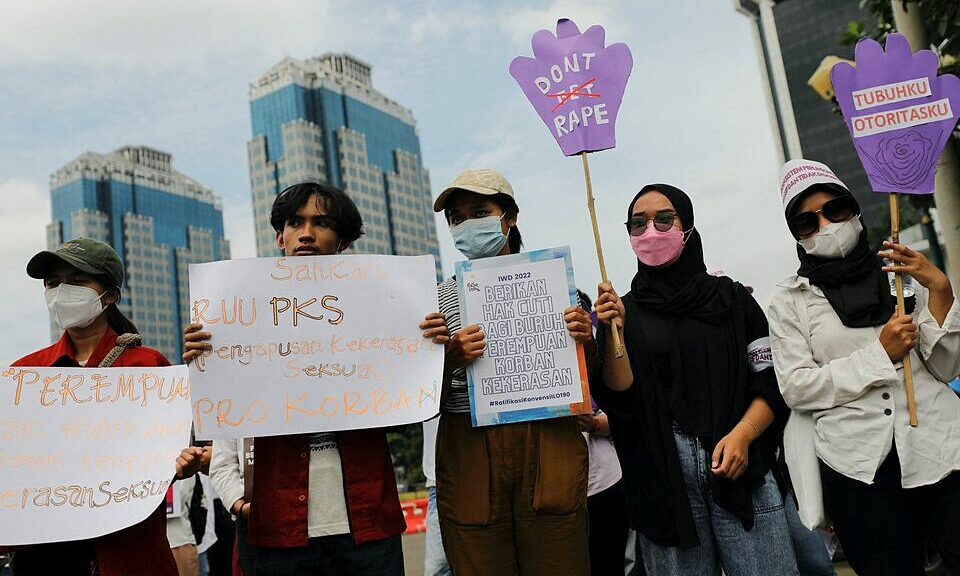
Activists carrying placards participated in a rally supporting women’s rights, calling for gender equality and protesting against gender discrimination, during International Women’s Day outside the National Monument (Monas) complex in Jakarta, Indonesia, on March 8, 2022. Photo by Reuters
The survey highlights the complex relationship between traditional gender roles and modern efforts to promote gender equality in Malaysia and Indonesia. While cultural and religious influences continue to shape societal attitudes, both nations are making strides in empowering women economically and socially.
Key initiatives include:
- Malaysia’s national program aimed at providing women with skills and opportunities, with a goal of increasing female labor force participation.
- Indonesia’s roadmap for achieving 70% women’s labor force participation by 2045, which includes better childcare services and maternity protections.
- Ongoing efforts by both governments to support women in leadership and career advancement, despite persistent traditional views on gender roles.
These developments reflect a growing recognition of the importance of gender equality in both countries, even as deep-rooted cultural norms continue to influence public opinion. As Malaysia and Indonesia navigate the challenges of balancing tradition with progress, the role of education, policy, and social awareness will be crucial in shaping a more equitable future for all.

Bahran Hariz adalah seorang penulis di Media Online IKABARI.