Malaysia’s durian tourism is experiencing a surge in popularity, with an increasing number of international travelers, particularly from China, planning their trips around the fruit’s peak seasons and key producing areas. This trend has been significantly boosted by the influence of social media, which has helped to spread awareness and interest in Malaysia’s unique durian offerings.
According to a recent report by BMI, a unit of credit rating agency Fitch Solutions, travelers are now timing their visits to Malaysia to coincide with durian harvests and are heading to orchards to sample different varieties directly from the source. They are also participating in curated, experience-driven packages that offer a deeper connection to the fruit and its cultivation.
While this trend is not entirely new—regional tourists such as Singaporeans have long traveled to Malaysia for “durian trips”—the rise of social media has amplified the phenomenon. How-to guides on Chinese platforms like Douyin, along with Malaysia’s visa-free policy for Chinese and Indian nationals, have further fueled the interest in durian tourism.
China is the world’s largest market for durian, importing $7.5 billion worth of the fruit last year. Thailand supplied $4 billion, while Vietnam contributed $3.4 billion. In comparison, Malaysia’s shipments were much smaller at $37.2 million, but its durians commanded significantly higher prices, averaging $12,138 per tonne compared to $4,239 for Thai and $3,739 for Vietnamese fruits.
Given the premium pricing, BMI noted that “many Chinese consumers are willing to make a specific trip to Malaysia for the greater quality and authenticity at a lower price tag.”

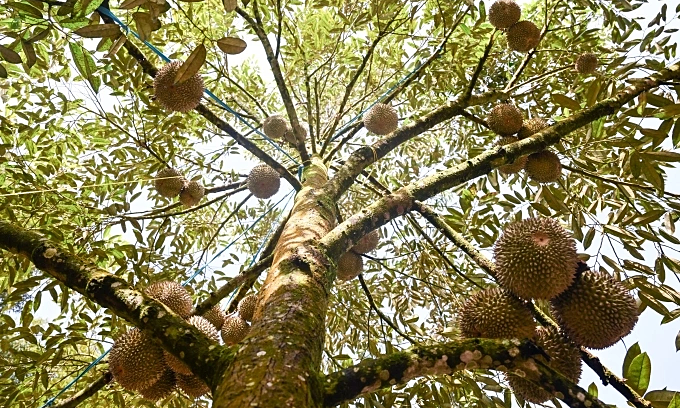
Durians are seen on the tree at a durian orchard in Raub of Pahang state, Malaysia, Oct. 16, 2025. Photo by Xinhua via AFP
The appeal of Malaysian durians extends beyond Chinese visitors. For instance, tourists like Harliandy Salim from Indonesia have made multiple trips to Bloopy Durians in central Malaysia, enduring a rugged drive through narrow, uneven tracks to reach the orchard.
“We have durians in Indonesia too, but the taste is not the same,” Salim, 43, who made the trip with his family in January, told Bloomberg.
A growing niche
Mohd Amirul Rizal Abdul Rahim, director general of Tourism Malaysia, said durian is emerging as a key niche in the sector. Stephen Loke, founder of Bloopy Durians, mentioned that visitors who travel to orchards often extend their trips into nearby cities for shopping.
During peak periods, Loke receives up to 180 guests a day, who come to learn about durian cultivation. Some of them choose to stay overnight and eat their fill of the pungent fruit.
BMI suggested that durian tourism could evolve into reservation-based tastings, curated orchard experiences, and luxury hotel packages that offer a distinctly Malaysian experience.
Malaysia welcomed 42.2 million visitors last year, marking an 11.2% increase year-on-year and a 20.4% rise compared to pre-pandemic levels in 2019. This makes it the most visited country in Southeast Asia.
To sustain this growth, the country is focusing more on niche attractions to differentiate itself in a competitive regional tourism market. The target is to welcome 47 million arrivals by 2026.
Malaysia has also been promoting and protecting its diverse durian varieties. In the eastern state of Sabah, durian bazaars, festivals, and competitions have been organized to showcase local harvests and highlight the region’s unique species, as reported by Channel News Asia.
Among these is Durian Merah, also known as red durian, which could become a major agro-tourism draw and commercial crop with proper cultivation and branding, according to The Star.
Additionally, the Intellectual Property Corporation of Malaysia earlier this year urged more farmer associations, producers, and state authorities to explore geographical indication registration for distinctive durian varieties linked to specific regions.
Despite potential challenges such as a stronger ringgit and rising regional competition, BMI’s outlook suggests that Malaysia could continue to attract travelers due to its combination of accessibility, competitive pricing, and unique offerings.

Bahran Hariz adalah seorang penulis di Media Online IKABARI.